
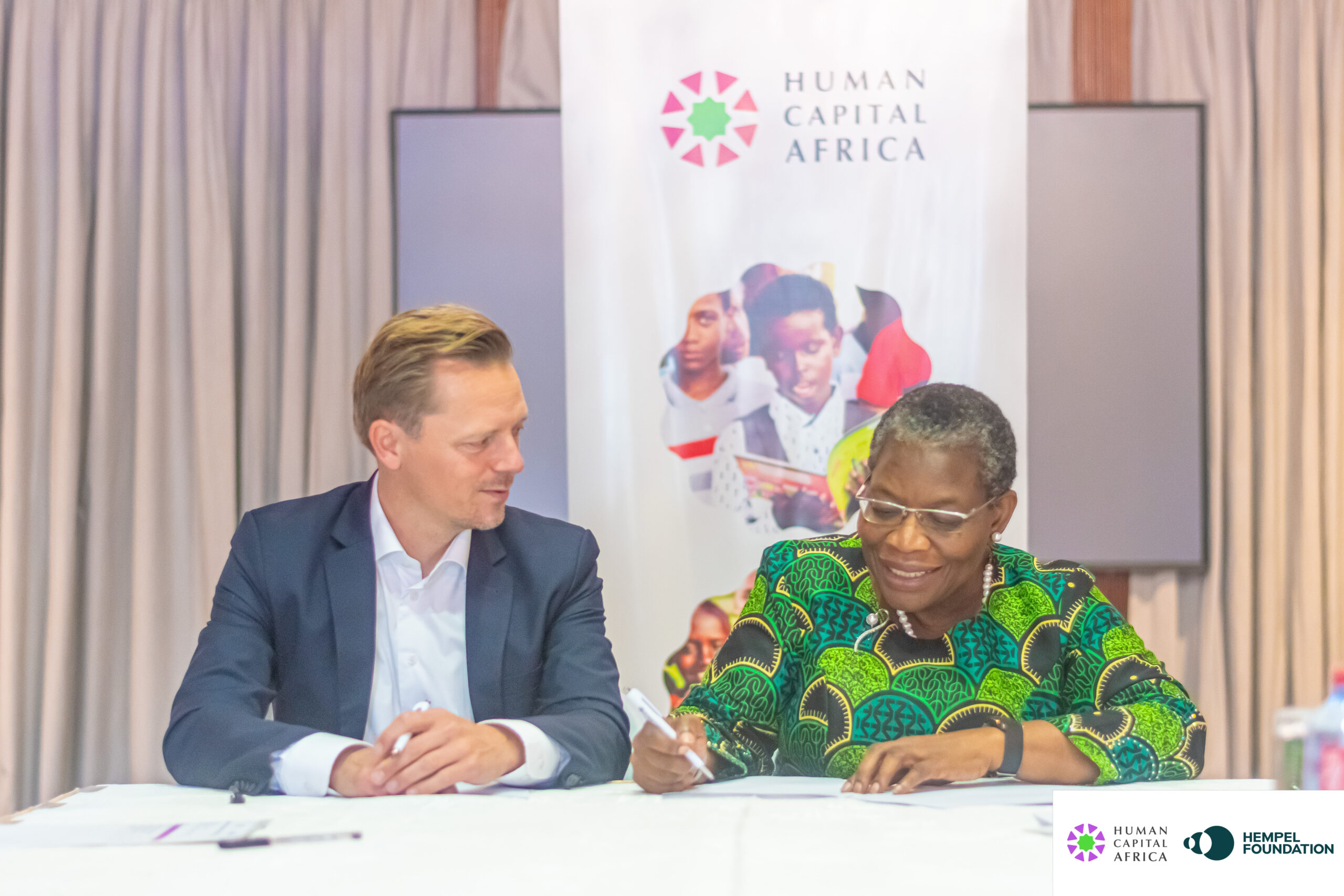
Accra, Ghana. | October 28, 2025: Human Capital Africa (HCA) and the Hempel Foundation have announced a landmark two-year partnership to strengthen political commitment, accountability, and data-driven reform for foundational learning across sub-Saharan Africa.
The partnership was officially launched during a closed-door session at the 2025 ADEA Triennale, attended by senior representatives from both organizations alongside key partners and education leaders. The initiative underscores a shared commitment to ensuring that every child in Africa learns to read, write, and count by age ten, a milestone that lays the foundation for all future learning and human capital development.
Addressing Africa’s Foundational Learning Crisis
Africa is home to the world’s fastest-growing youth population, yet nine out of ten children in sub-Saharan Africa cannot read or do basic mathematics by age ten. This learning crisis limits opportunity, deepens inequality, and threatens the continent’s economic potential, with the World Bank estimating a global loss of US$ 21 trillion in lifetime earnings in present value.
The HCA–Hempel Foundation partnership seeks to tackle this challenge by embedding foundational learning at the heart of education systems, fostering stronger political leadership, institutional accountability, and evidence-based decision-making through the use of data in advocacy, policy, and planning.
A Partnership Anchored in Systemic Change
The partnership will drive system-wide transformation across Africa by strengthening political leadership, deepening accountability, and reinforcing the institutions that sustain lasting reform. At the policy level, it will build and sustain high-level political momentum by engaging Heads of State, Ministers of Education and Finance, and other senior leaders to position foundational learning as a top development priority. Through this engagement, the partnership will elevate foundational learning on both national and continental agendas, ensuring it remains central to broader human capital and national development strategies.
A core pillar of this effort will be the strengthening of the African Foundational Learning Ministerial Coalition—a minister-led platform for peer learning, collaboration, and mutual accountability. By reinforcing this coalition, the partnership will help Ministers champion foundational learning within their own countries, foster cross-country exchange, and sustain a shared sense of purpose and progress. This work will also lay the foundation for a continental accountability mechanism to track progress and guide reform, ensuring that political commitments translate into measurable outcomes for children across the region.
Complementing this advocacy focus, the partnership will support governments in Malawi and Uganda to embed data use and accountability at the system and district levels. By applying tools such as the Adoption Tracker and FLAT, it will strengthen monitoring, promote evidence-based decision-making, and ensure that lessons from the classroom inform policy at every level.
Together, these efforts will drive regional alignment, reinforce political will, and translate commitment into tangible improvements in learning for every child.